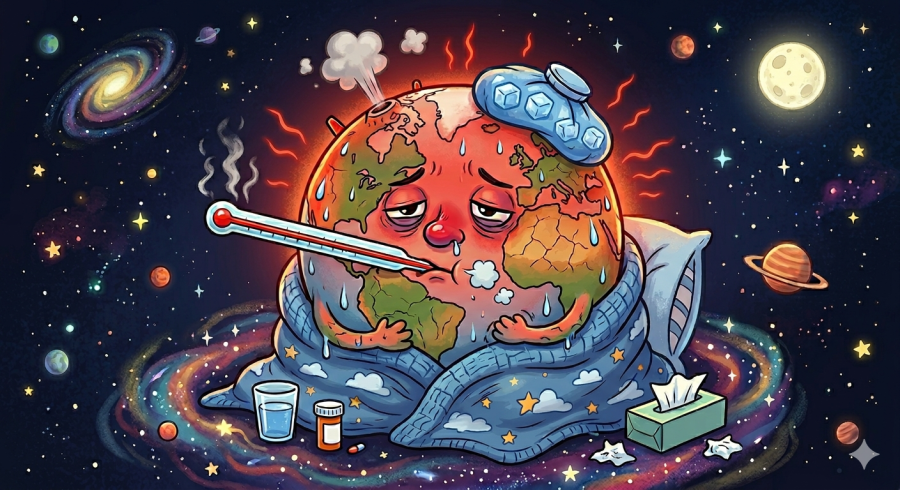
Climate change is accelerating. This is according to a study coordinated by PIK in Potsdam (Germany), which describes an accelerating warming trend over the last ten years compared to previous decades [1]. Never in Earth’s recent history has global temperatures risen so rapidly [2]. The cause is anthropogenic greenhouse gas emissions, and if we don’t decisively change course, we’re headed for approximately 2.7°C of global warming compared to the pre-industrial period by 2100.
The discovery isn’t that shocking, considering that the warmest years on record are 2023, 2024, and 2025 [3], but reading it written down in black and white in a scientific journal is still something. It’s increasingly likely that we’ll exceed the 1.5°C threshold set by the Paris Agreement sooner than expected. Supporting this are data on the Earth’s energy balance (the difference between energy entering the atmosphere and energy leaving it), which show a more and more evident imbalance [4]. Some measures implemented in recent decades to improve air quality (such as new fuels for maritime shipping) have also unintentionally contributed to the problem, by reducing the amount of solar radiation reflected from the atmosphere back to space.
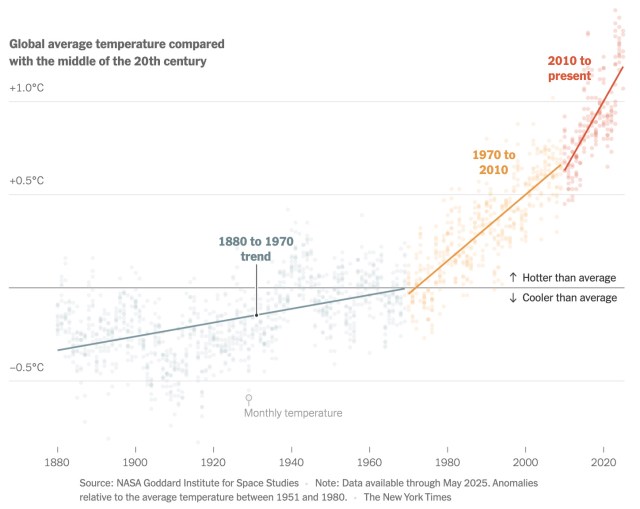
Science thrives on debate, and climatology is no exception. Not all experts agree on the best way to measure and represent this acceleration. Consider this figure published in 2025 by The New York Times. It seems overwhelming evidence that global warming has accelerated sharply since 2010. However, be wary while comparing different time periods: the first trend is over 90 years (1880-1970), the second over 40 years (1970-2010), and the third only 15 years (2010-2025). Not exactly a fair comparison.
The World Inside a Supercomputer
In any case, a global warming acceleration is happening, is increasingly evident, and, above all, is exactly what was expected [5]. The latest report (AR6) from the leading scientific authority on climate (Intergovernmental Panel on Climate Change, IPCC), released in 2021, analysed simulations from many climate models, predicting that global warming would be more rapid in this decade than in the past [6]. Even more importantly and worryingly, the acceleration could continue in the future. How do models predict this?
Climate models are numerical programs containing everything we know about the Earth’s climate; they are invaluable allies in understanding the past, present, and future of the climate. Just like all math problems, however, there is always more than one solution. Models in fact are not all the same. There will never be a super climate model capable of predicting everything, like Deep Thought in The Hitchhiker’s Guide to the Galaxy (to which we already know the answer anyway). In fact, the science is going in the opposite direction: using many different models, each with its own strengths and weaknesses, that simulate the climate under the same conditions.
Despite huge progress (not that older models have done a bad job, on the contrary), models still have significant strides to make. For example, some models show exaggerated global warming (Hollywood-level mass extinction). This is a major problem because those “hot” models influence climate scenarios and the estimate of the greenhouse gas emissions curb needed to comply with the Paris Agreement. According to the hot models, not even a huge reduction in emissions would be enough to keep climate change under control. Climate scientists are trying to find a solution.
Unity is Strength(?)
There are several ways to create climate scenarios. For example, you can make a climate model simulate a sudden increase in the atmospheric concentration of greenhouse gases; this is useful for understanding how models respond to shocks. Or, you can use a more realistic configuration and gradually increase the concentration of greenhouse gases, like we are doing with Earth’s climate. The latest IPCC report includes five scenarios. Low-emission scenarios project smaller increases in global temperature, or even a reduction for net-zero emissions scenarios; high-emission scenarios, on the other hand, project an almost uncontrolled increase in global warming.
Unlike the Italy national football team, climate models play together emphasising the strengths and downplays the weaknesses of each player. In the past IPCC reports, climate simulations were evaluated together to understand the average trend of the present and future climate. Basically, the Avengers of climate. Unfortunately, the aforementioned hotheads make everything more difficult. Hot models have very high climate sensitivity, resulting in a very strong temperature response to changes in greenhouse gas concentrations. Estimating the sensitivity of the climate is essential to understanding how much time and room for action we have to solve climate change.
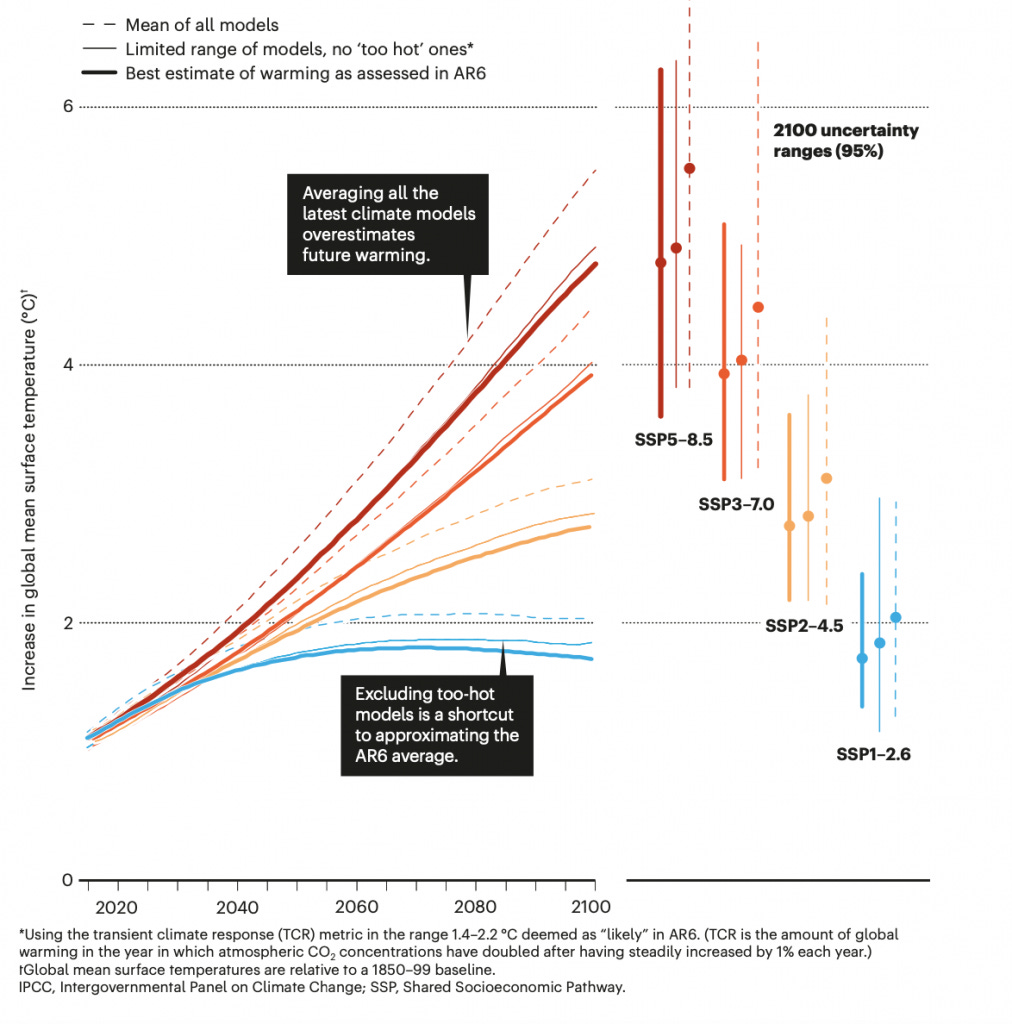
Over the years, various approaches to the problem have been proposed. This figure shows three [7] [8].
The traditional, democratic approach: each model is considered, without exception. The average is calculated considering all models, even the hot ones. The dotted lines in the figure were obtained with this approach for each scenario. With high emissions, there are models that predict over 6°C of global warming by 2100 and even 18°C by 2300 (assured extinction). Even with low emissions, global temperatures would exceed the 2°C warming threshold.
The meritocratic approach: Not all models are considered, but only those that best simulate Earth’s past and recent climate—that is, those with a climate sensitivity similar to that observed in the real world. This excludes all hot models and leads to lower global temperature estimates: from 4°C for high emissions to less than 2°C for low emissions.
The IPCC AR6 approach: assessed warming. The global warming trend obtained from each model is coupled with an “emulator,” a much more rudimentary numerical simulation than the original simulation, which helps scientists correct each model’s estimate of the climate response to make it more realistic based on Earth’s past and recent climate. This produces a slightly lower estimate of the climate response than the meritocratic approach.
Ending Up Like a Turkey
The IPCC AR6 approach is a significant improvement over the traditional one, providing much more realistic and precise estimates of climate change to inform policy and public opinion on the state of the problem. The emulators substantially reduce the complexity of the underlying model and use statistics to assess its climate response. Artificial intelligence, however, is increasingly used, both for assessing the climate response of models and for improving the models themselves, and they promise to revolutionize climate science in the near future.
However, we can’t be truly sure that hot models are unrealistically too hot. Just like Bertrand Russell’s poor turkey, it’s risky to base future climate scenarios (and all the political and economic decisions that derive from them) on the past, otherwise we risk ending up roasted (literally). Global warming levels of 5-6°C are the same as those that separate glacial and interglacial periods. These are such changes that we have no idea how to manage. The best thing to do is to cut greenhouse gas emissions down to zero as soon as possible and avoid the extremely dangerous “turkey scenario.”
Note: The original version of this article can be found here: https://www.noidiminerva.it/hot-model-climatici/.
SOURCES
[1] https://agupubs.onlinelibrary.wiley.com/doi/10.1029/2025GL118804
[2] https://www.carbonbrief.org/pace-of-global-warming-has-nearly-doubled-since-2015-study-says/
[3] https://wmo.int/news/media-centre/wmo-confirms-2025-was-one-of-warmest-years-record
[4] https://wmo.int/news/media-centre/earths-climate-swings-increasingly-out-of-balance
[5] https://www.theclimatebrink.com/p/the-great-acceleration-debate
[6] https://www.carbonbrief.org/factcheck-why-the-recent-acceleration-in-global-warming-is-what-scientists-expect/
[7] https://www.carbonbrief.org/guest-post-how-climate-scientists-should-handle-hot-models/
[8] https://www.climateforesight.eu/articles/the-hot-model-problem/
 My Climate Science Blog