
Sheldon Cooper was wrong. Geology is a real science. The debate over the recognition of the Anthropocene is the best example.
The Anthropocene is the name of Earth’s current geological epoch, at least according to several scientists. The concept of the Anthropocene was introduced in the 19th century, proving that debates about geological epochs can last as long as the geological epochs themselves. Italian geologist and paleontologist Antonio Stoppani named it “Anthropozoic.” The same concept was later renamed “Anthropocene” and made famous by Nobel Prize-winning chemistry winner Paul Crutzen. For many decades now, we have been experiencing the huge impact of humans on our planet, which has only since increased: greenhouse gas emissions, deforestation, and mass extinctions are just a few examples. We are changing the planet at an unprecedented rate, and the risk is that these changes will become the new normal or even irreversible.
According to official geology, we are actually in the Holocene (holos, completely; kainos, recent), which began around 12,000 years ago, at the end of the last glacial period. It’s the most important time for us, because our civilization was born and developed entirely during this period. Some even propose starting the counting of years from that moment, to give them a more universal meaning, detached from any religious content; according to this standard, we would now be in the year 12025 of the human epoch. There’s even a calendar if you want to buy it [1].
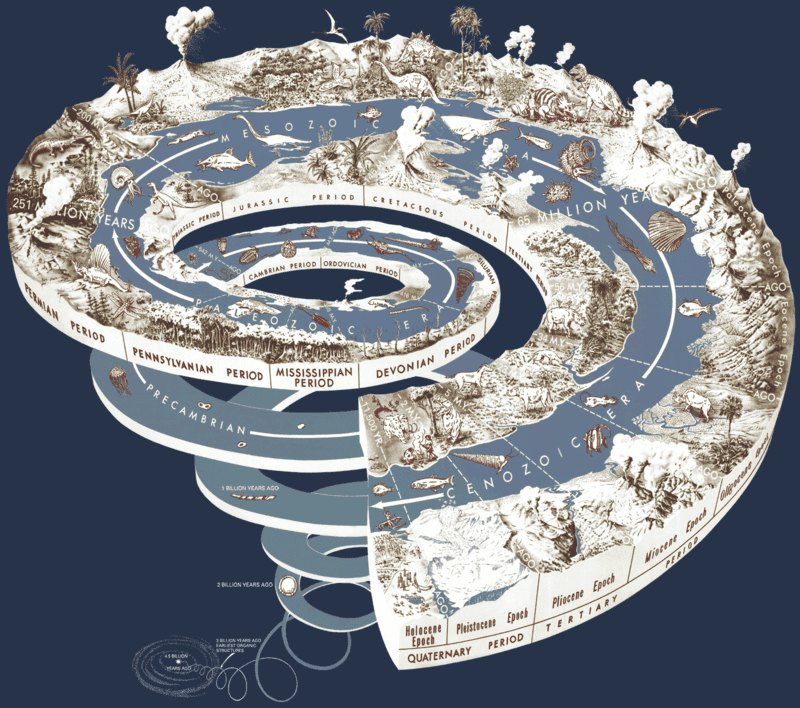
Earth’s geological history spiral. Credits: Joseph Graham, William Newman, John Stacy/United States Geological Survey.
Back to the Anthropocene. Recently, debate became more heated within the scientific community. Initially, many scholars used the term Anthropocene to describe the last few centuries of geological history [2], placing it alongside the official Holocene. The intention was not to introduce a new epoch, but only to highlight how much the Earth has changed due to human activities. The name, in fact, has no meaning (ànthrōpos and kainos mean “human” and “recent,” respectively) and is simply a variant of the name Holocene.
The concept of the Anthropocene, however, has evolved over time, featuring on the agenda of many scientific conferences. Calls have become increasingly louder to consider the Anthropocene a geological epoch in its own right, separate from the Holocene. In 2008, finally the Stratigraphic Commission of the Geological Society of London formally considered adopting the Anthropocene as a new geological epoch [3]. Humanity’s footprint on Earth is now impossible to hide, even in the most remote places on the planet. In theory, it would seem like a very easy decision. However, it is not so simple.
Like real science, geology moves with caution. The criterion by which geological epochs are separated is not what’s visible on the surface, but what’s beneath [4]. Do you know those streaks that make rocks look like slices of cake? Each tells the story of the geological era in which it formed. The discipline studying and classifying those layers is called stratigraphy. Therefore, to determine whether we are in a new geological epoch, the Anthropocene must have left an indelible mark on the stratigraphic history of our planet, as the previous ones did.
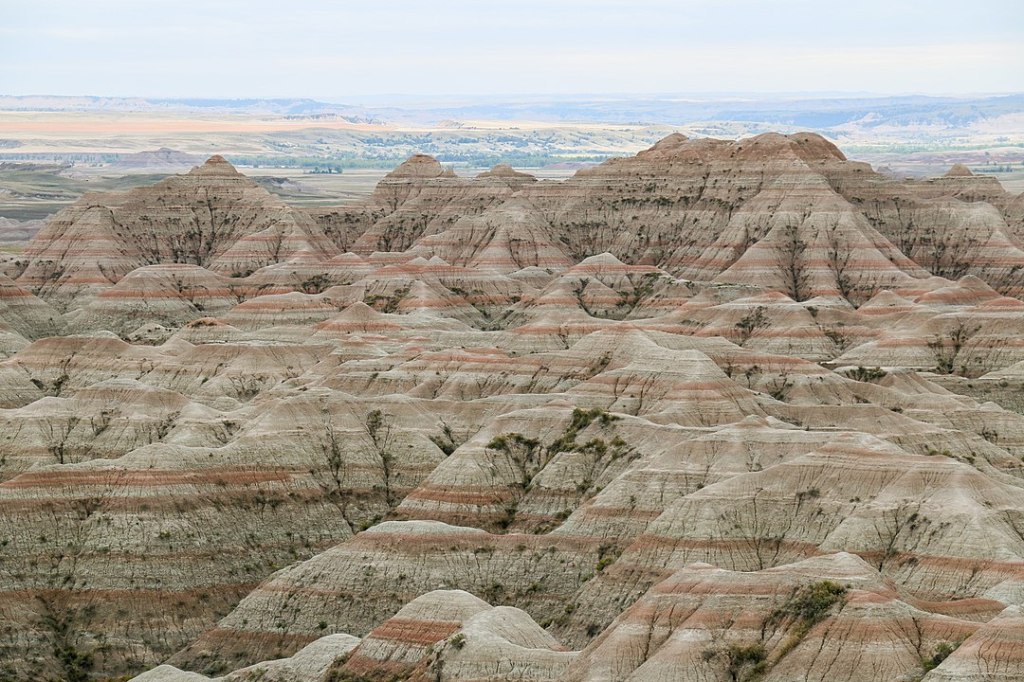
Stratified rocks in Badlands National Park, South Dakota, US. Credit: Martin Kraft – Own work, CC BY-SA 3.0, https://commons.wikimedia.org/w/index.php?curid=38552942.
That’s the problem there. After years of investigations and debates, in 2024 a specific working group of the International Commission on Stratigraphy (the highest scientific authority on the subject) decreed that there is insufficient evidence that the Anthropocene is a true geological epoch. Stratigraphic clues are not yet definitive, but above all, a precise start date for the Anthropocene is lacking, especially if biological as well as geological aspects are considered [5].
For example, the discovery of America and the beginning of European colonialism radically changed the face of entire continents; would 1492 CE therefore be the start of the Anthropocene? And what about the industrial revolution; since around 1850, it caused an uncontrolled surge in atmospheric greenhouse gases. Maybe the first nuclear bombs dropped on Japan and all the following nuclear tests, of which geological traces remain everywhere? There is no agreement on a start date even among experts, let alone among rocks.
The usual “skeptics” have used the decision on the Anthropocene as an excuse to attack universally recognized scientific phenomena, such as climate change. In reality, the commission didn’t reject the Anthropocene as a concept, but only claimed that there is not yet enough evidence to consider it as a geological epoch [6]. The smoking gun, the murder weapon, is not yet there. The matter is far from closed, as the debate is still open; some scientists have even resigned from the commission in protest against the decision.
The commission’s opinion should not actually surprise us [7]. Not enough time has passed to see the signs of human activity imprinted unequivocably in the Earth’s crust. It’s a kind of presbyopia, the inability to focus on nearby objects. We are too close to the terrible effects of our activities on the planet to assess them properly. We don’t yet have the ability to understand when we began to significantly transform the Earth, at least according to geology. It is up to the geologists of the future to understand how and when this happened, with all due respect to Sheldon Cooper.
Note: The original version of this article can be found here: https://www.noidiminerva.it/antropocene-si-no/.
SOURCES
[1] https://shop-eu.kurzgesagt.org/collections/calendar/products/12-026-human-era-calendar?variant=55341282656633
[2] https://education.nationalgeographic.org/resource/anthropocene/
[3] https://rock.geosociety.org/net/gsatoday/archive/18/2/pdf/i1052-5173-18-2-4.pdf
[4] https://www.bgs.ac.uk/discovering-geology/fossils-and-geological-time/geological-timechart/
[5] https://www.nhm.ac.uk/discover/what-is-the-anthropocene.html
[6] https://www.science.org/content/article/anthropocene-dead-long-live-anthropocene
[7] https://www.nature.com/articles/d41586-024-02712-y
 My Climate Science Blog