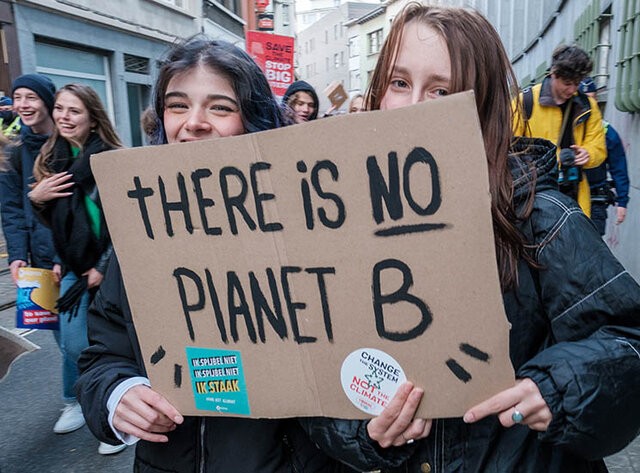
The 29th Conference of the Parties on Climate Change (COP29) is starting today in Baku, Azerbaijan. This week, like every year, scientists, economists, and politicians gather to discuss how to solve the ongoing climate crisis.
The goal of this conference is to keep acting on reducing greenhouse gas emissions, caused mainly by the use of fossil fuels, and to limit the increase in global temperature within 1.5°C with respect to the pre-industrial period. This threshold shouldn’t to be exceeded if we want to avoid the worst effects of climate change (as if they weren’t dangerous already).
The goal was enshrined into the Paris Agreement, adopted at COP21 in 2015 by nearly all countries. A turning point that has yet to find a real implementation; with current emission reduction policies the global temperature will warm up to 3°C by the end of this century [1]. Year 2024 will likely be the hottest year ever recorded; the global mean temperature has been at record levels for almost the entire year, above 1.5°C [2].
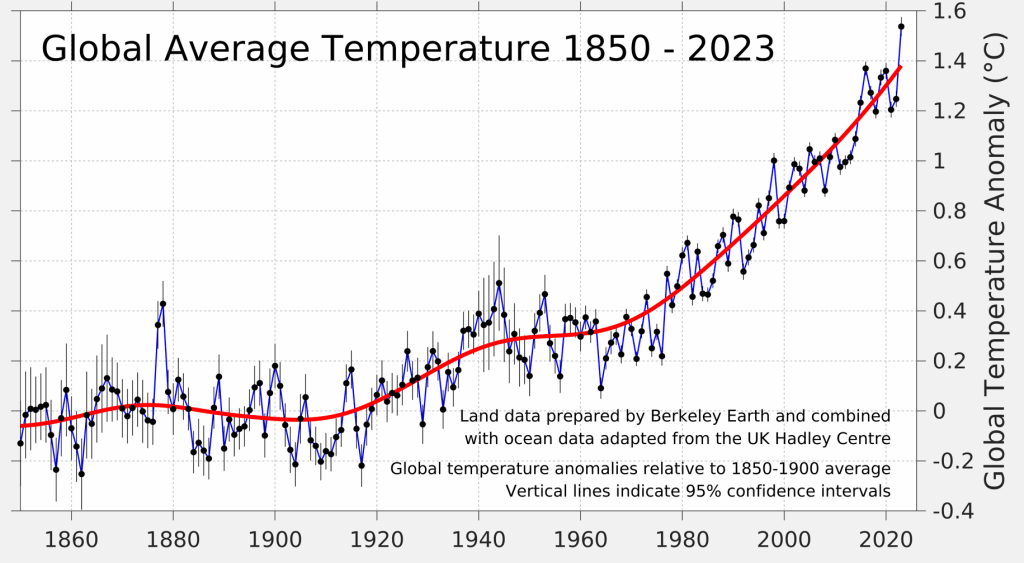
Global mean temperature from 1850 to 2023 relative to the average of the 1850-1900 period (pre-industrial period). The dots represent the annual average of temperature with the relative margin of uncertainty, represented by the vertical line. The blue line indicates the annual trend, the red one the long-term trend [3].
Hold on. Have we already passed the 1.5°C threshold? Has the Paris Agreement failed? Not quite. Climate changes over much longer timescales than us. One year is a considerable period of time for humans, but for the climate it’s a heartbeat. One year can be particularly warmer or colder than the others, for example because of processes having temporary effects on the climate, such as volcanic eruptions or El Niño. Greenhouse gas emissions, on the other hand, have a lasting effect; they steadily increase the amount of energy stored in the climate – and consequently the global temperature – until they stop (or so we think). So, the effect of CO2 and other greenhouse gases on the climate must be examined in the long term, at least on timescales of 20-30 years.
And here lies the catch: technically, the 1.5 degree threshold is exceeded only if the 30-year average temperature exceeds that limit; at the moment the 30-year average is around 1.3 degrees. There’s more: according to the Paris Agreement, the 1.5 degree limit should not be exceeded by the end of this century [4]. It means that, under the agreement, the 1.5 degree threshold can be temporarily exceeded and then returned below the limit by 2100. This concept is known among scientists as climate overshoot.
Are you getting an headache at this point? So do I. Perhaps we are aiming at the wrong target though. The 1.5 degree threshold is important, but the key point is that every tenth of a degree counts. From a legal point of view, we need to set a numerical limit to calculate the reduction of greenhouse gas emissions at global and national levels. However, this is relatively irrelevant for people. As human beings, we are sensitive to floods, extreme events, heat waves, crop failures, and climate tipping points. All of these are already seriously impacted by the current global warming, regardless of the threshold we set. This is why this year’s COP is important, as it is every year. It helps us understand where we stand in this race for our survival.
Unfortunately, the road to COP29 had already started out uphill. COPs are held in different regions of the world in rotation. This year’s COP was to be hold in Eastern Europe, which includes EU countries like Poland, as well as countries like Ukraine and Russia. It’s easy to see why choosing a host country that everyone agreed was almost impossible. In the end, a compromise was found with Azerbaijan, which however is practically a petrostate, just like the United Arab Emirates that hosted the COP last year. Azerbaijan has also recently been accused of using the event to increase its domestic production of fossil fuels and of using fake social media profiles to suppress dissent.
Other than reducing emissions, another important issue at hand is finance. The goal of 100 billion dollars a year for the Loss and Damage fund, created by the Paris Agreement to help developing countries facing the climate crisis, needs to be updated. I have already wrote on this topic in the past [5]. The problem is one: there is never money for this. In October the biodiversity COP held in Colombia failed because of this very point: many developed countries don’t want to allocate the necessary funds to create a global fund for protecting global biodiversity. It’s feared that COP29 will undergo the same fate. Last but not least, the reelection of Donald Trump as US president further complicates things, given his positions on climate and the environment.
What can we do to improve the situation? In addition to the usual things, such as eating less meat and using low-emission energy sources, there are other more incisive actions. For example, stop investing in fossil fuels (you don’t have to be rich, it’s enough to have a bank account) and put pressure on Parliaments and Governments to obtain effective emission reduction policies. A small step for us, a big step to protect humanity.
Image credits: Han Soete. Copyright: Attribution-NonCommercial-ShareAlike 4.0 International (CC BY-NC-SA 4.0).
Note: The original version of this article can be found here: https://www.noidiminerva.it/accordo-di-parigi-ha-fallito/.
SOURCES
[1] https://www.unep.org/resources/emissions-gap-report-2024
[2] https://www.carbonbrief.org/analysis-what-record-global-heat-means-for-breaching-the-1-5c-warming-limit/
[3] https://berkeleyearth.org/global-temperature-report-for-2023/
[4] https://www.climatecouncil.org.au/resources/have-we-already-gone-past-1-5-degrees-warming/
[5] https://giorgiograffinoclimate.earth/2024/03/19/when-will-global-warming-stop/
 My Climate Science Blog
Pingback: Climate overshoot: How to fail with style – My Climate Science Blog