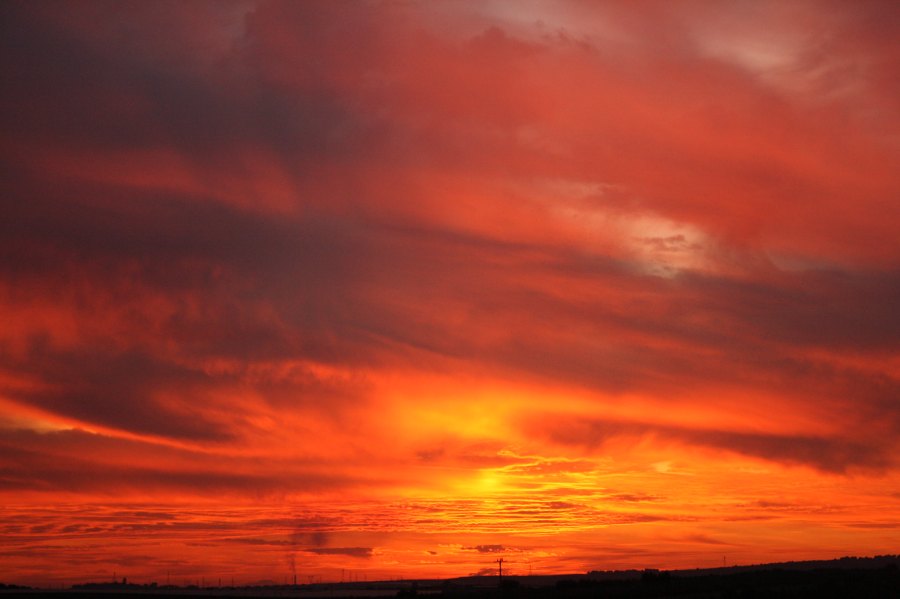
Sunsets are arguably one of the most fascinating natural phenomena. According to popular belief, however, red sunsets reveal something ominous: air pollution. The more polluted the air, the redder the sunset. Bummer!
There’s some truth in this, but it should be taken with a big pinch of common sense. It’s true that particulate matter (solid particles suspended in the air; also called aerosols) makes the sky redder, but there’s a limit. Let’s explore why, starting with an example: the most famous saying about weather and sunsets.
Red sky, blue sky
According to popular wisdom, when the sky is red at sunset, there’s a good chance the weather will clear: “Red in the sky, shepherds’ delight.” It seems a bit naive, but it’s true. It all depends on light. Visible sunlight consists of radiation ranging from blue-violet (400-490 nm wavelength) to red (650-680 nm); 1 nm is equal to one billionth of a metre. The scattering of sunlight in the atmosphere depends on how the light interacts with air particles. When the particles are very small, such as air molecules (nitrogen, oxygen, …), the phenomenon is governed by Rayleigh’s law: the scattering of radiation depends on the inverse of the fourth power of the wavelength (1/λ4, where λ is the wavelength).
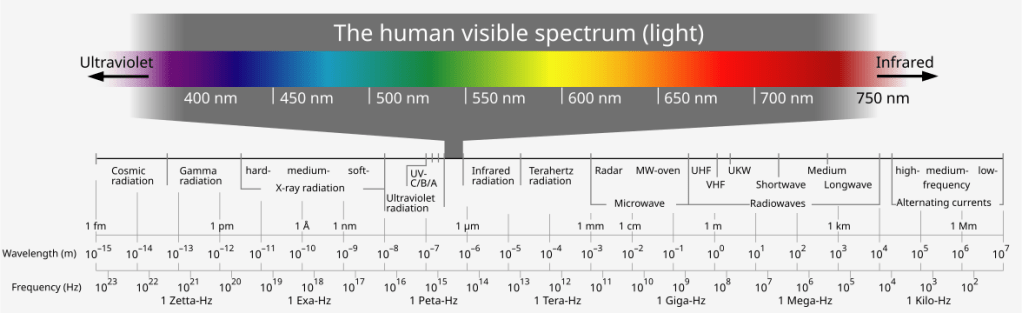
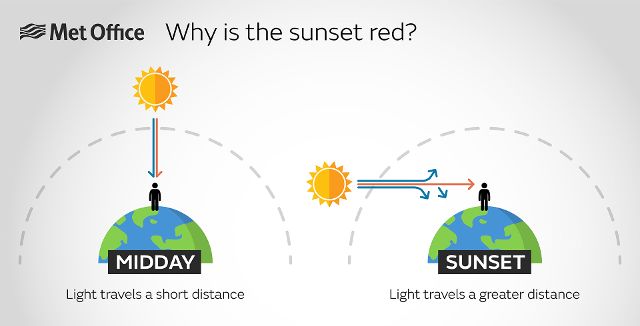
Normally, shorter wavelengths, such as blue and violet, are scattered more than longer wavelengths (red and orange), thus reaching our eyes more easily. This explains, for example, why the sky appears blue when the sun is high in the sky; this is also because our eyes are more sensitive to blue than to violet [1]. At sunset, when the sun is close to the horizon, the light passes through a thicker layer of the atmosphere; in this case, the diffusion is so intense that the blue-violet radiation is dispersed, leaving mostly the red light [2].
In the case of “Red in the sky, shepherds’ delight,” they were right. Goes without saying, this is not a rigorous weather forecasting method (weather models remain our best ally), but it does have a scientific basis. If your country is located at mid-latitudes, 30°N to 60°N, most weather storms will hit you from the West [3], which is also the direction in which the Sun sets.
Radiation does not interact with all atmospheric particles in the same way. When the air is rich in water vapour, due to its high humidity, radiation is attenuated more, so sunsets don’t have a distinct red hue. This happens when a weather disturbance is approaching from the West. When, however, the sunset is bright and red, the air is dry, and no weather disturbances are approaching (at least from the West). The same goes for the other expression “Red in the morning, shepherd’s warning”: when the sky is red in the East at dawn, it means that dry air is being pushed eastward by a weather disturbance arriving from the West, meaning bad weather is imminent [4]. No orcs involved. Sorry, Legolas.
Smog and Sunsets
We’ve seen that the colour of the sky depends on how radiation interacts with atmospheric particulate matter. In an atmosphere completely devoid of particulate matter, a sunset would never be bright red, but at most reddish. Nothing spectacular. For a proper sunset, you need just the right amount of particulate matter.
This is the key: the concentration of particulate matter. There is always some particulate matter in the atmosphere, whether of natural or human origin. Examples of natural sources of particulate matter include seas, deserts, forest fires, and volcanic eruptions. Particles produced in small quantities by natural sources are uniform in type and size, interacting with sunlight in similar ways and thus creating spectacular sunsets [5]. For example, the gigantic eruption of the Indonesian volcano Krakatoa in 1883 caused extraordinarily red sunsets around the world, inspiring the Norwegian artist Edvard Munch to paint his famous “Scream”. The distance between Indonesia and Norway is approximately 11,000 km, proving that the atmosphere knows no boundaries.
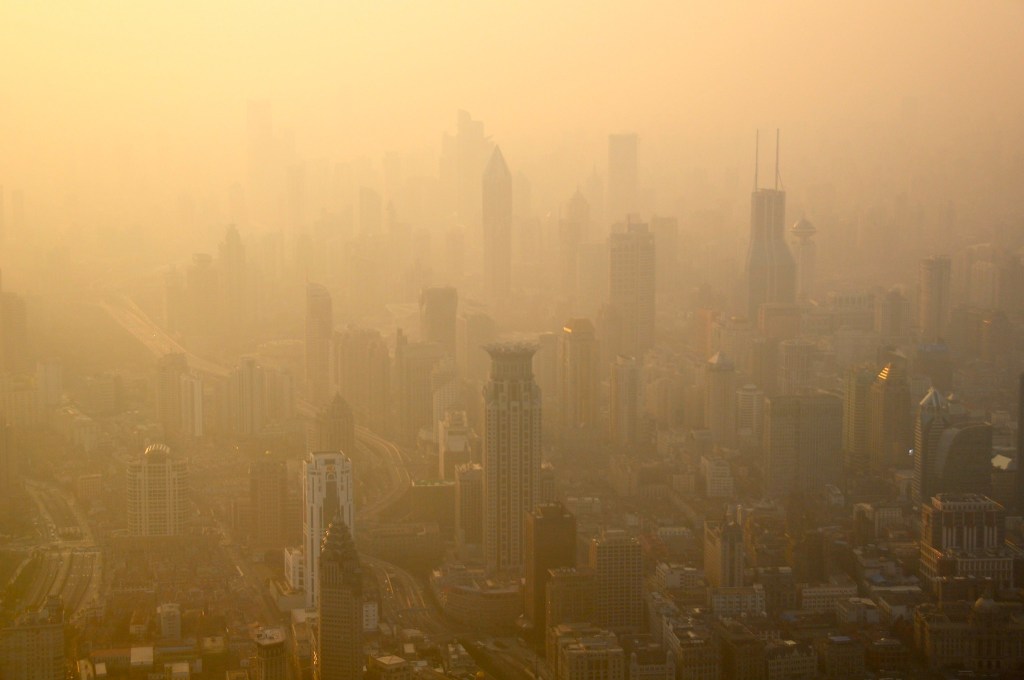
Human sources of particulate matter are mainly factories, power plants, domestic heating, and cars. In a large city, these particulate emissions are so abundant that natural particulate matter becomes negligible. Unlike natural particulate matter, however, anthropogenic particulate matter comes in many different types and sizes. Some interact with radiation in the same way as natural aerosols, thus contributing to the red colour of the sky. Larger particles, however, can completely block radiation, as can excessively high concentrations of particulate matter. At that point, the sky will no longer be red but a dull colour [6]. Certainly nothing memorable.
Reducing air pollution in large cities not only benefits our health [7] but also lets us enjoy spectacular sunset views.
Note: The original version of this article can be found here: https://www.noidiminerva.it/rosso-di-sera-aria-inquinata-che-tira/.
SOURCES
[1] https://weather.metoffice.gov.uk/learn-about/weather/optical-effects/why-is-the-sky-blue
[2] https://weather.metoffice.gov.uk/learn-about/weather/optical-effects/why-is-the-sunset-red
[3] https://youtu.be/XmmIIpO8o9M?si=2pB8a3-Udq73unAs
[4] https://weather.metoffice.gov.uk/learn-about/weather/how-weather-works/red-sky-at-night
[5] https://www.scientificamerican.com/article/fact-or-fiction-smog-creates-beautiful-sunsets/
[6] https://science.howstuffworks.com/environmental/green-science/smog-sunset.htm
 My Climate Science Blog