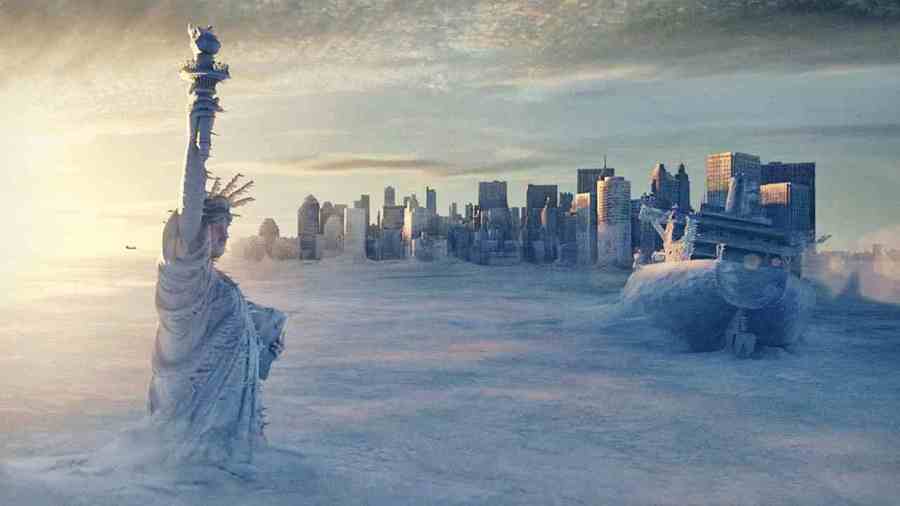
Imagine a boundless stretch of ice. Picture it in your mind. Smooth, dazzling, seemingly eternal. Something happens, though. The ice begins to break, endangering the unfortunate protagonists on the ice sheet.
If you thought about the opening scene of “Ice Age”, you almost got it right. Instead of an adorable prehistoric squirrel and his beloved acorn, in this case the problem is climate change. In “The Day After Tomorrow” (2004) the protagonist is Jack Hall, an expert of the paleo-climate of the Earth, which is the study of the Earth’s past climate. The initial setting is the Larsen C ice shelf in Antarctica, which is actually at risk of collapse. For example, in 2016 a huge fracture opened in the platform, leading to the detachment of iceberg A-68, twice the size of the state of Luxembourg. The film was prophetic about this, but the rest unfortunately is really not up to the mark.

As much of Roland Emmerich’s filmography (“Independence Day”, “2012”, “Moonfall”), “The Day After Tomorrow” also shows a global catastrophe unfolding before our eyes. We are not dealing with aliens or ancient prophecies here, but all of us. Human emissions of greenhouse gas are causing a buildup of energy in the climate [1], increasing global mean temperature, ice melting and extreme weather events. The protagonist knows that a catastrophe is imminent and that humanity is gambling on their future, but his attempts to warn the authorities of the danger are rejected by politicians, concerned more with the economy than with environmental issues. The dialogue between the US vice-president (“Who will pay the price for climate action?”) and the protagonist (“Doing nothing to fight climate change will cost much more than doing something”) is emblematic. The same script happens in reality every year at the COP, where climate scientists warn about the impact of anthropogenic climate change, while politicians shrug their shoulders.
In essence, the plausible part of the film ends here. Instead of wildfires, heat waves, and droughts, Emmerich proposes an unexpected scenario: the beginning of a glacial period, like the one that ended about 12,000 years ago. In the film the North Atlantic ocean current suddenly stops due to the melting of the Arctic ice cap, starting a chain effect that leads to a large part of the Northern Hemisphere being covered by ice in the span of a couple of weeks. All anticipated by enormous out-of-season migrations of animals, giant hailstones in Japan, and multiple tornadoes in California. As in all films where a scientist is ignored, the situation gets critical. People do not have time to escape and the victims of the sudden frost are countless. Rich countries need to ask developing countries for help to find refuge, in a sharp contrast to the current global situation. The film then ends with astronauts on the International Space Station contemplating the new ice age from above.
Let’s get one thing straight: a glacial phase doesn’t happen that quickly. The climate has enormous inertia, so it takes thousands of years to go from an interglacial period (like the current one) to a glacial period (like the one in the film). However, I can forgive the film screenwriters for the speed at which the events occur; after all, it is impossible to make a film about events happening over thousands of years (unless you’re Peter Jackson). In the last million years there has been a fairly regular alternation between glacial and interglacial periods. The cause is the very slow changes in the Earth’s orbit known as Milanković cycles, strengthened by various feedback mechanisms amplifying the initial change until it becomes permanent. This is why changes in global temperature and atmospheric greenhouse gas concentration are well correlated over time, because they influence each other [2].

Don’t panic. As important as it is, the collapse of the North Atlantic Current cannot kick the start of a glacial period [4]. Furthermore, current scenarios of future climate change predict a weakening of the current, but not a total block [5]. I’m afraid I must therefore reject Emmerich’s thesis. The way the story unfolds is also absurd, with “cold” hurricanes the size of entire continents forming at latitudes where hurricanes physically cannot exist, described using terms that have nothing to do with meteorology. A big mess.
However, there is something very instructive in the film. The speed with which events unfold is not realistic, but it resembles something similar to the concept of tipping points. I said before that small changes can be amplified by climate feedbacks [6], radically changing the climate even in a permanent way. Think of pushing a boulder up a hill. When you reach the top of the slope and start going down, the boulder will begin to descend faster and faster because of gravity; at that point the process becomes unstoppable until a new equilibrium point is reached (that is, the end of the descent). The climate works in the same way: one “push” too many and we could find ourselves in a final state of equilibrium very different from the initial one.
How close are we to triggering climate tipping points? There is a lot of research at the moment on this. According to the IPCC (Intergovernmental Panel on Climate Change, the highest global authority in climate science), if the increase of global temperature compared to the pre-industrial period remains below 1,5°C, tipping points should remain under control (the conditional is a must). However, we are getting dangerously close to the threshold. Year 2023 is officially the hottest on record so far, with a terrifying temperature anomaly ranging between 1.34°C and 1.54°C depending on the dataset [7]. The image below looks like a famous Joy Division cover, but it doesn’t show anything joyful. Those are daily global temperature data for all years from 1940 to 2023; the anomaly is calculated relative to the period 1990-2020 and shows a clear increase in warmer than average days as time passes.

Year 2023 was also warm because of El Niño, a phenomenon that tends to boost global temperatures and which will probably end in 2024. This year will therefore very likely be a record one too. Is everything lost? Absolutely not. When El Niño ends, global temperatures will drop slightly, but we cannot rest on our laurels. The threshold will definitely be surpassed before the end of this decade, unless we drastically reduce our greenhouse gas emissions. Better to stop pushing the boulder, if we don’t want it to crush us.
Note: The original version of this article can be found here: https://www.noidiminerva.it/alba-del-giorno-dopo/.
SOURCES
[1] https://climate.nasa.gov/causes/?uuid=7s5I11U6T46sjVXG3254
[2] https://news.climate.columbia.edu/2021/02/25/carbon-dioxide-cause-global-warming/
[3] https://skepticalscience.com/print.php?r=33
[4] https://www.whoi.edu/oceanus/feature/are-we-heading-toward-another-little-ice-age/
[5] https://www.whoi.edu/oceanus/feature/whats-happening-with-the-amoc/
[6] https://www.nature.org/en-us/what-we-do/our-insights/perspectives/climate-change-butterfly-effect/
 My Climate Science Blog
Pingback: When will global warming stop? – My Climate Science Blog