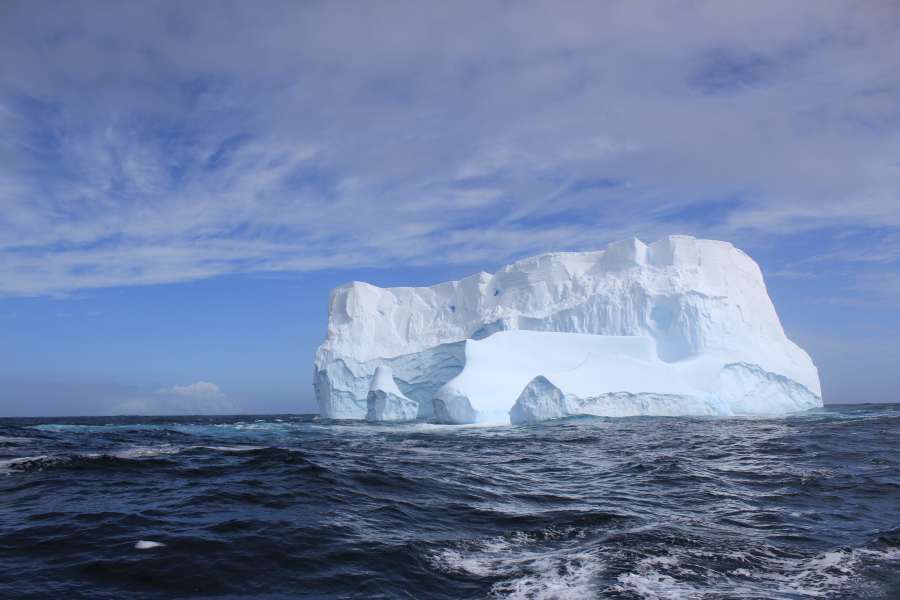
Hearing news of huge icebergs detaching from the polar ice shelves is becoming increasingly frequent. The latest is about the ice mass now called A-81, which detached from the Brunt ice shelf in Antarctica. The event was captured by the ESA satellite Sentinel-2, also letting experts to monitor all the stages of formation and widening of the rift on the shelf, until the final detachment of the iceberg. As usual, we indulged in finding comparisons for the size of the iceberg: the size of that chunk of ice is roughly twice the size of New York City, or five times the area of Malta. Either way, one could fill more than a few cocktail glasses with that ice.
An ice shelf is a massive permanent structure formed by floating sea ice, between 100 and 1000 metres thick. The largest in the world is the Ross ice shelf, located in Antarctica; it’s almost as big as France. Those structures are formed as an extension of glaciers and polar caps, protruding from the continent into the sea; as such, the shelves form a brittle prop for the ice on land to keep it from crumbling into the water. Specifically, the Brunt shelf is located in the Weddell Sea, one of the southernmost sea basins in the world. Being so close to the South Pole, it is partially or completely frozen (depending on the season), although the ice cover has decreased significantly in recent years. This lack of ice affects the entire continent, which is losing sea ice at a worrying rate. In fact, there is recent news of ships breaking records for the southernmost point ever reached in the Ross Sea, also in Antarctica. This is possible only because the ice layer crossed by the ships is particularly thin.

The Southern Ocean, which is the one surrounding the Antarctic continent, is home to thousands of icebergs, detaching from the coast for wandering for weeks and eventually melting. Some of these are real giants. In addition to navigation (do you remember Jack and Rose?), they can also endanger the surrounding ecosystems, as with the iceberg A-68, which detached from Antarctica and was carried by the sea current to the island of South Georgia (part of a British Overseas Territory, not to be confused with the Caucasian nation or the American state), leaving many to fear for the delicate ecosystem of the island. Luckily it was a false alarm, since the iceberg did not manage to reach the island; however, the large amount of water released by its disintegration left some damage to the island environment.
The polar regions are unfortunately much more sensitive than other places to the effects of the recent climate change, due to the so-called “polar amplification”, leading to a much greater increase in surface temperature at the poles than the global average. The Arctic is warming about four times the global warming rate, while for Antarctica it’s a factor three. As a result, the Antarctic continent is becoming greener. The increase in vegetation would be great news if it happened anywhere else on Earth, but not on an ice-covered continent so important to the global climate. That’s right. As the climate system is strongly interconnected, what happens in Antarctica has consequences for the entire globe.
First of all, a clarification. Floating sea ice is already in the water, so it does not contribute to sea level rise when it breaks up. However, as already mentioned, the ice shelves give a fundamental support to the ice caps on the continent. If the shelves disappear, the continental ice can slide down more easily into the ocean, thereby raising sea levels. This effect, in addition to the increase in temperature, is alarming for the fate of several Antarctic glaciers. Furthermore, there is a more subtle element to consider, which is part of the feedback mechanisms typical of the climate system. They are basically virtuous or vicious cycles, amplifying or reducing the effects of a given process on others. In this case, the melting of ice (marine and otherwise) leads to a net warming for the climate. Let’s see together why.
The ice melting leads to an increase in solar radiation absorbed by the Earth surface, due to the ability of ice to reflect almost all of the incoming radiation (just think of how easy it is to get sunburn when you spend a sunny day on the snow); this property is called albedo and has a cooling effect on the climate. This increased absorption is especially relevant at the poles, given the enormous amount of ice available. The main consequence of the absorption of solar radiation is an increase in temperature, which reinforces the phenomenon of ice melting and the absorption of more solar radiation, which causes further warming. This is an example of positive feedback, in the sense that the initial process is amplified, much like a vicious circle.

The climate system has many of these feedback mechanisms, which makes it highly non-linear and susceptible to ‘points of no return’, in which vicious circles dramatically amplify a given process to the point of making it impossible to return to the initial state. For this very reason, the threshold of global warming considered not dangerous by the IPCC (the Intergovernmental Panel on Climate Change, made by the leading climate experts) is set at 1.5°C with respect to the pre-industrial period, i.e. before our activities began to release large quantities of greenhouse gas into the atmosphere. In brief, our current knowledge suggests that no tipping points should be reached within that threshold of global temperature increase, thus preventing climate change from going out of control. In 2022 we reached 1.15°C, so the gap of staying below that threshold is closing rapidly. As the saying goes, we are on thin ice.
Note: The original version of this article can be found here: https://www.noidiminerva.it/quello-che-succede-in-antartide/.
 My Climate Science Blog
Pingback: When will global warming stop? – My Climate Science Blog