The recent climate change doesn’t have the same impact everywhere. Some regions are most affected by it, both from a social and an economic perspective. In general, there is an increase in heatwaves and soil aridity, sea level rise, and an increase in diseases dangerous for humans. This could get worse in the future, and climate scenarios are certainly not encouraging.
Unfortunately, so far the worst effects of climate change are seen in developing countries [1], both for their geographical position and the lower adaptability of their economic system. Nonetheless, developing countries are the least responsible for the ongoing climate crisis, given their modest contribution in terms of greenhouse gas emissions. This is undoubtedly an ethical problem, linked to the concept of climate justice. The last global climate conferences tried to address the problem, but there is a lot of reluctance on action by developed countries.
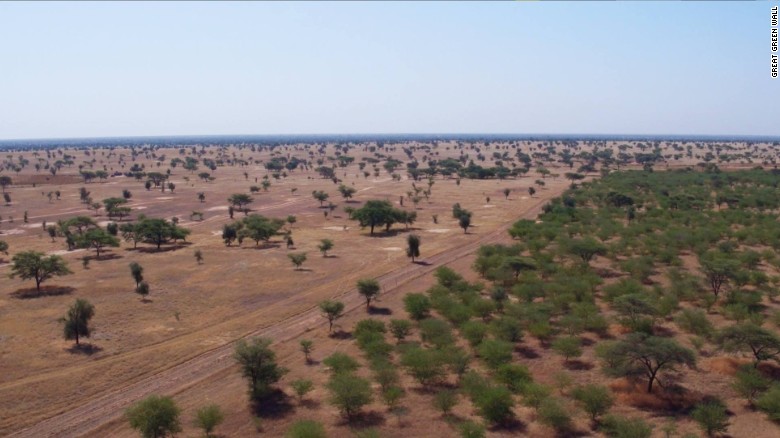
So it is no wonder that many countries are starting to find solutions on their own. One of the most remarkable initiatives is the Great Green Wall. The initial project forecasted an 8000 km “wall of trees” to fight desertification, extending from the Atlantic to the Indian Ocean in the Sahel region in sub-Saharan Africa. Being squeezed between the Sahara desert and the savannah, the Sahel is one of the regions most at risk from climate change, with wider consequences in terms of migrations and geopolitics.

There were several problems though [2]. First of all, the allocated funding was not sufficient to complete the project. Second, rainfall patterns in the region are changing, so it’s not easy to figure out where to plant trees to make them survive and thrive. We must also take into account the local economy, mainly relying on agriculture and farming. All social and economic consequences of the project must be carefully evaluated.
There were also many who argued that the initial project was not addressing the problem in a fair way [3]. Planting and growing so many trees in that region is impossible; the local climate does not allow it. Furthermore, many areas are uninhabited, so nobody can follow the tree growth on a regular basis. Actually, the best solution to the advancing desertification had already been found by local farmers, thanks to their skillful practices in terms of water collection and biodiversity conservation. The project transformed over time from a utopian expanse of trees to a mosaic of virtuous land management practices.
According to a UN report, as of 2020 nearly 18 million hectares of land have been restored [4]. The first positive outcomes are already visible, especially in Ethiopia, Niger and Eritrea, with an increase in the vegetation density and agricultural crops, and a reduction in soil degradation. As a side effect, this has also led to a reforestation of those areas. The 2030 goal is very ambitious: restoring 100 million hectares of degraded land in the region, thus contributing to the absorption of millions of tons of CO2 from the atmosphere, ensuring food for millions of people.
A similar initiative was started in China [5], where the Gobi desert is ever more advancing in the North-West of the country. Started in 1978, the project has already planted 66 million trees, aiming to reach 88 million in 2050. However, it is not easy to understand whether the project is actually working against desertification, with many trees dying soon after being planted, and others requiring more water than what is available in that region. Certainly, the frequency of dust storms has decreased there, but it will take time to see the long-term effects.
Note: The original version of this article can be found here: https://www.noidiminerva.it/grande-muraglia-verde-storia-di-una-rinascita/.
Sources
[2] Scaling the Great Green Wall? | Independent Evaluation Group
[4] https://storymaps.arcgis.com/stories/2d681abc19cf43ff90514b6b1419b244
[5] China’s ‘Great Green Wall’ Fights Expanding Gobi Desert
 My Climate Science Blog