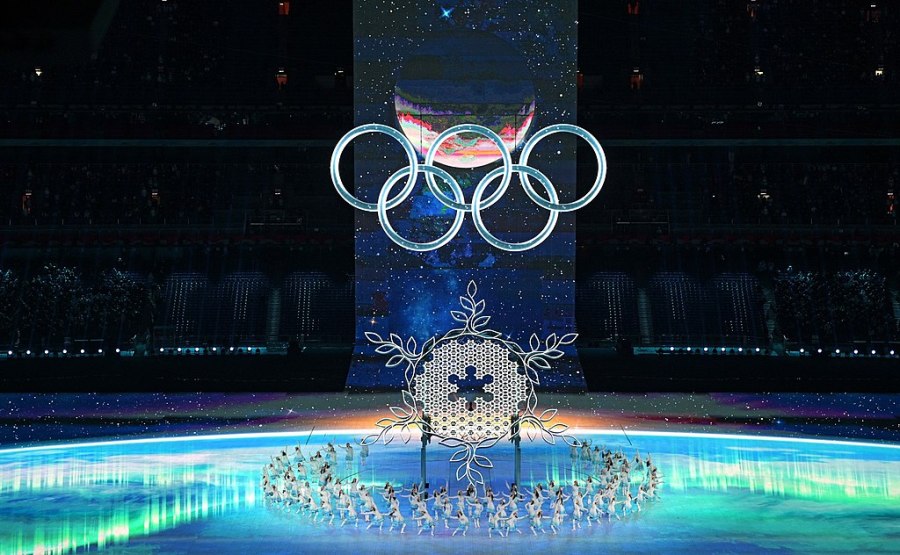
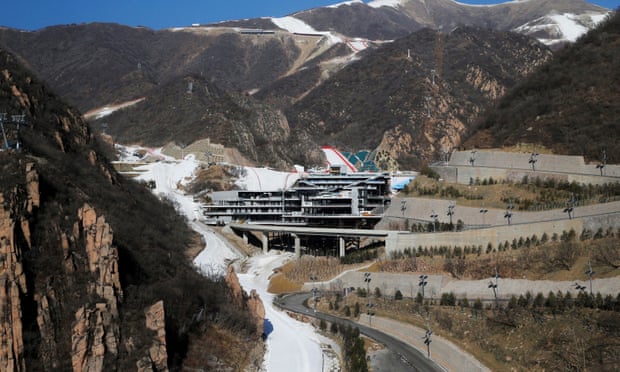
The Winter Olympic Games are being held in Beijing right now. In addition to the Chinese capital, the races are also held in the nearby mountainous areas of Yanqing and Zhangjiakou, which however are usually too dry to have a good snow cover.
The chronic lack of snow is the organisers’ main headache. One of the potential solutions is artificial snow, which is increasingly being used by ski resorts all around the world to make up for the lack of natural snow. Obviously this leads to sustainability issues (we’ll get back to it later), but first let’s get to the root of the problem: there is no snow. How come? Due to climate change: increasing global temperature means that in many mountain areas there are no longer the conditions for the snow to fall and stay intact for skiing safely. Of course, the lack of snow is a big problem not only for ski resorts, but also for water reserves and hydropower generation.
However, there is another dilemma. There is the well-founded fear that it will be increasingly difficult to find suitable places to hold the Winter Olympics, unless we rely exclusively on artificial snow as for Beijing 2022. This could mean saying goodbye to the Winter Olympics, at least in the European Alps (the next ones should be held in 2026 in Cortina d’Ampezzo, Italy) who have been struggling from lack of snow for several years now. Of course this depends on how much we reduce our greenhouse gas emissions in the near future, but forecasts are not rosy anyway.
However, artificial snow does not solve all problems. Indeed the organisers of some of the past editions had to come up with several ways to get all the snow they needed. For the Vancouver Olympics in 2010, some of the snow was transported by helicopter from other locations, while for Sochi in 2014, some of the snow was unfrozen from the previous winter. It is no coincidence that these difficulties have arisen in recent decades, given the acceleration of climate change being underway.
As you can see, the problems are many. Unfortunately, however, there is still one question that should not be neglected: how is all that artificial snow formed? The organisers claim that Beijing 2022 will be the first Olympic Games with net zero emissions (the word “net” is key here), but there are many concerns, given the amount of water and energy needed to produce it. Certainly not sustainable. Also, some of the race locations are close to, or even inside, a national park.
A word of caution: we are not claiming that the previous Winter Olympics were sustainable, mind you. Same goes for ski resorts in general. How to improve the game from an environmental perspective and make it survive climate change? The answer is not easy to find and many people (such as ski resorts managers) might not like it. Perhaps the best way to go would be to rethink our relationship with the mountains, like using paths and slopes for walks and tours, rather than depending exclusively on ski resorts and cable cars. Will we be up to the challenge?
Note: The original version of this article can be found here: https://www.noidiminerva.it/olimpiadi-invernali-in-estinzione/.
 My Climate Science Blog